
Catalytic Capital for Local News: Financing Resilience
How flexible, risk-tolerant capital can strengthen local news organizations and enable new investment
Local news plays a critical role in community life, but many news organizations are operating within financial systems that weren’t built to support them long term. Grants remain essential – but on their own, they may not be enough to help newsrooms weather change, invest in capacity, or navigate major transitions.
Catalytic capital offers another way to support strong, independent local news organizations that have investable business models – while staying aligned with community values and public purpose.
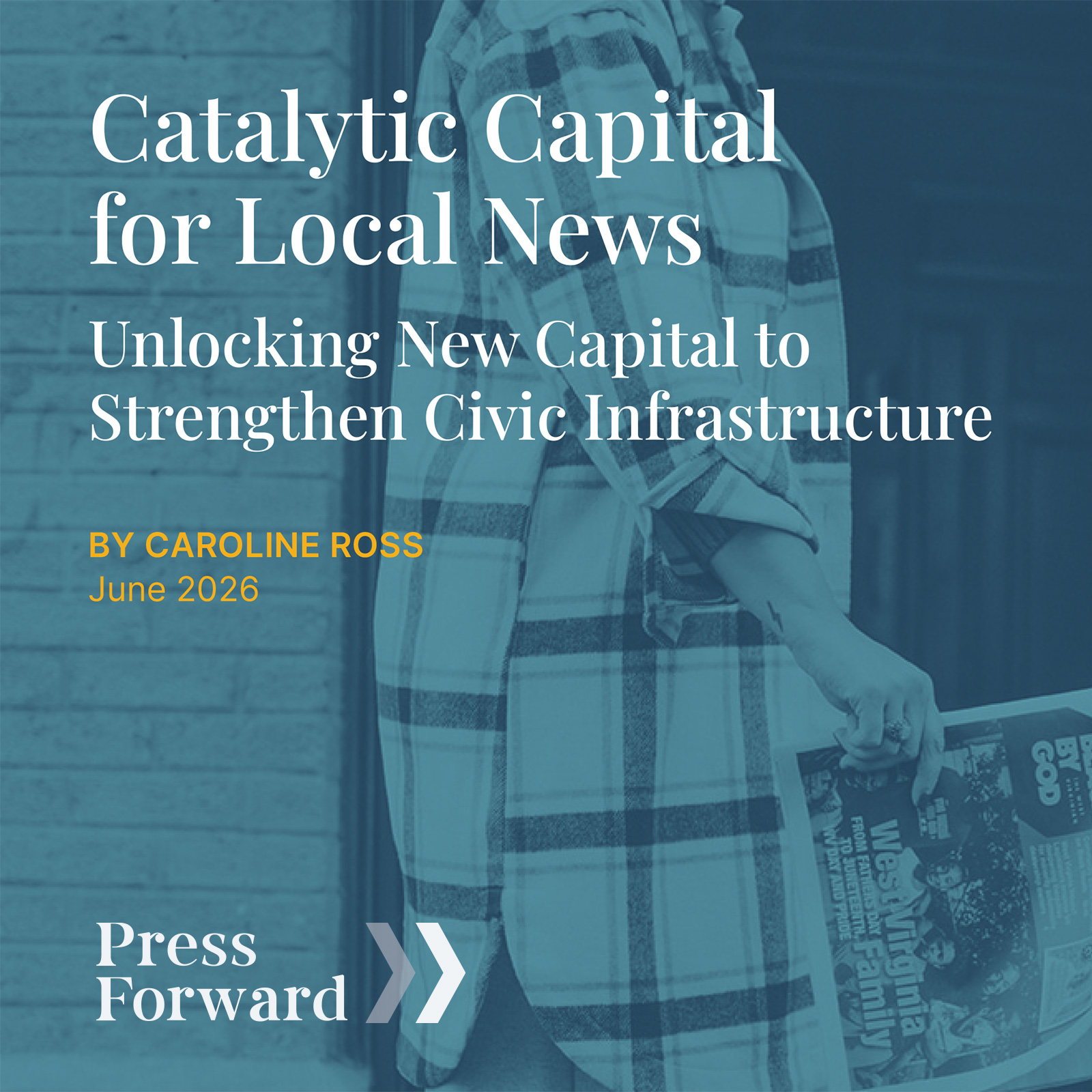
Explore Our New White Paper: Catalytic Capital for Local News
Local news doesn’t need just more money. It needs more kinds of money. Catalytic Capital is the missing middle. Learn more in this white paper by Caroline Ross. Explore Catalytic Capital for Local News.
What Is Catalytic Capital?
Catalytic capital is flexible, risk-tolerant investment designed to unlock social impact and additional investment that would not otherwise be possible. As defined by Tideline (2019) it prioritizes social outcomes over maximizing financial returns and is willing to accept higher risk, lower financial returns, or longer time horizons in service of mission-driven goals.
In practice, catalytic capital sits between traditional grants and conventional financing. Unlike grants, it is typically repaid and can be recycled to support future impact. Unlike bank loans or market-rate investments, it does not require perfect balance sheets or near-term returns.
This flexibility makes catalytic capital especially useful in sectors like local news where organizations are mission-driven, financially viable, and deeply rooted in community, but do not fit standard investment models.
How Catalytic Capital Works
Catalytic capital often is used alongside other types of support, including grants and technical assistance.
It can help organizations bridge common capital gaps — such as cash flow constraints, ownership transitions, or infrastructure investments — that can limit stability or growth.
The Prime Coalition offers a useful, step-by-step, framework to get started with developing catalytic capital tools in your own community.
Where It’s Worked Before
Across sectors, catalytic capital has helped unlock new models and stabilize essential institutions:
- Community development, by catalyzing growth and development while seeking equitable outcomes for lower-income neighborhoods, mobilizing capital at the deal-, enterprise-, and neighborhood-level.
- Climate and energy, through the acceptance of disproportionate risk or blended finance structures that accelerate adoption of climate solutions.
- Arts & culture, by supporting mission-driven arts and culture organizations with patient, flexible capital tailored to the needs of their sector.
- Emerging markets, through blended finance structures that facilitate the flow of capital to the Sustainable Development Goals (SDGs).
Case Studies and Field Perspectives
How Catalytic Capital Can Support Local News
Local news organizations face a set of challenges that many funders and operators recognize firsthand:
- Unpredictable revenue, especially from advertising and subscriptions
- Ownership transitions, where the future of a newsroom, and its community mission, is at stake
- Limited infrastructure, from technology to staffing to shared services
Because of these realities, many newsrooms don’t fit neatly into traditional funding models. Catalytic capital can help fill the gap, supporting stability through transition.
Ways Catalytic Capital Can Be Used in Local News
Catalytic capital can be deployed in a few common ways.
In some cases, it is pooled into a blended finance fund, where different types of capital, including grants, concessionary investments, and other funding are combined under a shared strategy. Each source of capital plays a different role in the overall structure, helping balance risk and impact.
In other cases, catalytic capital is provided directly to organizations or projects. These investments may be made earlier, on more flexible terms, or with a higher tolerance for risk than conventional financing – helping attract additional funders or lenders over time.
Catalytic capital can utilize familiar financial tools, including:
Debt
Loans with lower interest, flexible or revenue-based repayment terms, or in a subordinated position relative to other investors.
Guarantees
Loan guarantees can reduce financial risk and unlock capital from other lenders or investors.
Equity
Long-term, values-aligned ownership stakes in mission-driven media ventures can provide patient capital for growth and enable additional investment.
Capital Grants
Grants or recoverable grants that can take on first-loss risk within a capital structure. In addition, technical assistance grants serve as an important complement to catalytic capital, helping to strengthen operations, governance, or systems, helping to make organizations more investable over time.
Moving Forward
This project is ongoing. We are continuing to listen to leaders across the field to better understand where catalytic capital can be most useful in local news.
In the near term, this page will continue to evolve as a practical resource: a place to share emerging examples, clarify available pathways, and help news organizations and funders better understand the catalytic capital landscape.
Later in 2026, we plan to publish a guide designed to help funders and field leaders consider catalytic capital and the future of local news. That guide will reflect what we learn through this first phase of the project and will serve as an invitation for continued feedback as this work evolves.
If you’d like to be notified when the guide is available or learn about any other project updates, please sign up for our project e-mail list below.
Who’s behind this project?
This project is funded and led by Press Forward staff, including Dale Anglin, Melissa Milios Davis, and Marika Lynch. Research and facilitation are led by Caroline Ross of Valentin Co.