

The Gates Family Foundation helped the National Trust finance a new local printing press.

Melisa Milios Davis, Press Forward’s Director of Grantmaking
Over the past several years, many of us in the Press Forward network have been working toward the same goal from different angles: building a more resilient, community-rooted local news ecosystem.
We’ve made real progress. New outlets have launched. Collaborative models have emerged. Philanthropy has stepped up in unprecedented ways. Still, we are bumping up against a structural challenge.
Traditional grantmaking, while essential, is not always enough to help local news organizations build durable business models or make the kinds of investments that position them for long-term sustainability. Meanwhile, traditional lending, which organizations of all types often tap into for growth or new ventures, isn’t always affordable or accessible for newsrooms operating on slim margins.
That’s where catalytic capital comes in.
Today, we’re launching a new guide and case studies for funders and field leaders, and written by Caroline Ross, to begin exploring this idea more deeply. Later this summer, we’ll publish a full white paper.
We want to acknowledge up front that local media is a rapidly changing landscape filled with many unknowns, which has kept many traditional lenders at bay. Meanwhile, for many newsrooms, the idea of taking on debt to grow a local media business is unfamiliar territory, and there is good reason to be cautious.
That’s why we’re approaching this work with clarity and a commitment to sharing what we learn.
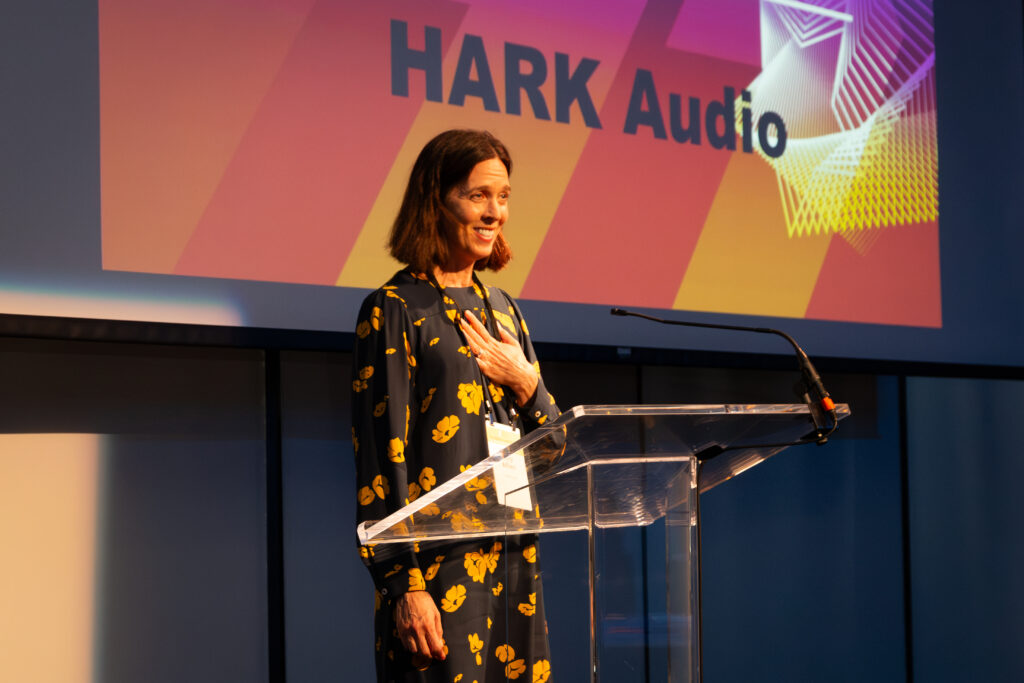
Hark Audio receives a 2024 Next Challenge award, a project of the Glen Nelson Center at American Public Media, which utilizes catalytic capital.
What we mean by catalytic capital
At its core, catalytic capital is flexible, risk-tolerant capital intentionally designed to take on more risk, be more patient, or accept lower financial returns to unlock outcomes that wouldn’t happen otherwise.
In the context of local news, that might look like:
- Low-interest loans to support expansion or acquisition
- Revenue-based financing tied to earned income growth
- Guarantees or credit enhancements that help organizations access traditional capital
- Program-related investments (PRIs) that blend mission and financial sustainability
Many funders are familiar with catalytic capital in other areas, such as climate change or affordable housing. Catalytic capital has helped these fields to mature and grow. We’re hoping these proof points will guide the way for catalytic capital to help revitalize local news.
What I’ve seen up close
My own interest in catalytic capital didn’t start in theory, but in practice.
 During my time at the Gates Family Foundation, I had the opportunity to work alongside colleagues on a set of impact investments to strengthen Colorado’s local news ecosystem.
We asked ourselves: How might we support news organizations that are vital to the community and on a path to sustainability, but need the right kind of capital to get there?
In one case, we provided flexible, patient capital that allowed a digital news organization to grow its footprint and deepen its impact. In another, we backed a loan that helped keep a network of family-owned newspapers under local control.
You can read more about these efforts in Colorado here.
What I realized is that catalytic capital is not a silver bullet, and should be considered with caution:
- Not every newsroom should take on debt.
- Not every organization is ready for repayable capital and
- Not every funder is positioned to deploy it effectively.
But these tools can be a vital component of a holistic approach to strengthening the field. In each case, the risks we calculated were well worth the community benefit.
And there is a growing opportunity for more funders and news leaders to learn from one another and use these tools thoughtfully.
A preview of what we’re learning
As part of this work, Press Forward has partnered with Caroline Ross, who has deep expertise in both impact investing and local news entrepreneurship, to document early case studies exploring how catalytic capital can be applied to local news.
Each reflects a different approach and a set of lessons. Here are a few highlights:
- Investing in innovation and technology for local news: The Glen Nelson Center at American Public Media is demonstrating how early-stage, risk-tolerant capital can support experimentation and new models within and beyond public media, offering a window into how innovation can be seeded in legacy systems. Read more.
- A place-rooted model for strengthening local news: The Rural News Fund in Central Appalachia highlights how locally anchored intermediaries can deploy flexible capital to meet community-specific needs, strengthening both individual outlets and the broader news ecosystem. Read more.
- Increasing access to capital for community media: The Media Resilience Fund focuses on closing capital gaps for local news entrepreneurs and enterprises that are often left out of traditional funding pathways. Read more.
For funders: an invitation to explore
If you’re a place-based or national funder in the Press Forward network, this work is an invitation to begin asking:
- Where might grants alone not be enough?
- What risks are you willing to take to unlock new possibilities?
- How can you learn from and partner with others, be they intermediaries, CDFIs, or peer funders,to do this well?
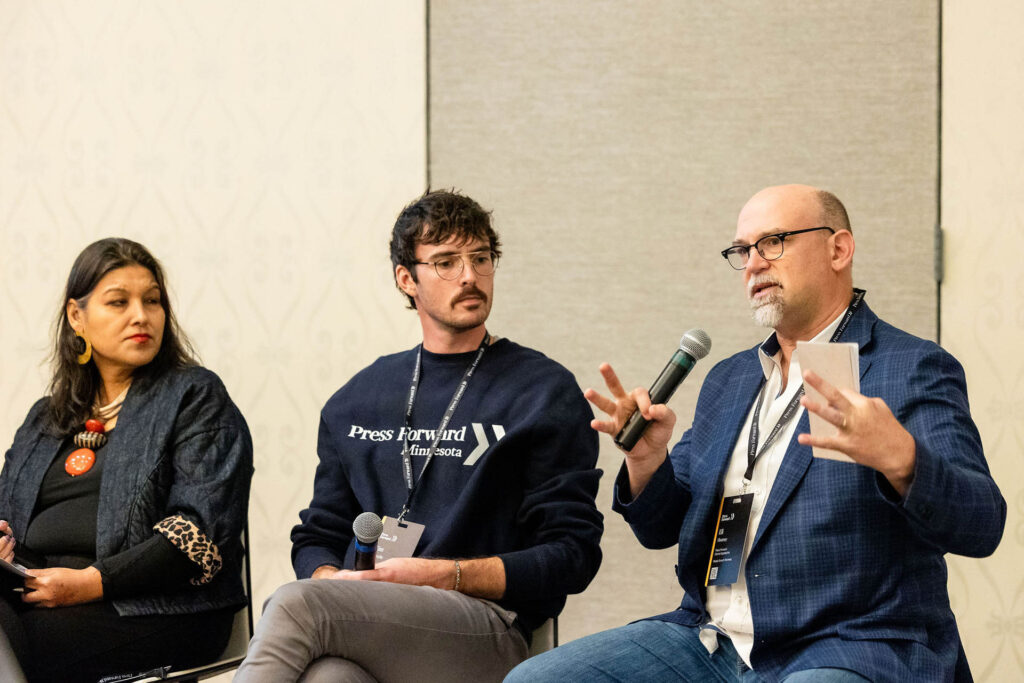
Eli Flournoy of Press Forward Appalachia talks about the Rural News Fund’s use of catalytic capital at a Press Forward event.
In many cases, the most effective role for philanthropy may not be to invest directly, but to enable investment through a loan guarantee, first-loss capital, or grants for capacity-building to help news entrepreneurs manage their financing.
If you or a colleague plans to attend the Mission Investors Exchange conference in Atlanta later this month, please consider joining a session on April 28, where Caroline Ross, who wrote our case studies, will talk about catalytic capital for news.
If you are just curious, funders can register for a special briefing on June 22, when we’re partnering with Media Impact Funders to host a webinar to dive into this topic.
We’ll also continue to surface case studies, share lessons, and create space for honest conversation about what’s working, what’s not, and what’s still uncertain.
If this conversation about catalytic capital can help us move closer to a more resilient local news ecosystem nationwide, it’s worth exploring carefully, collaboratively, and with a clear sense of purpose.
Melissa Davis is Press Forward’s Director of Grantmaking.