

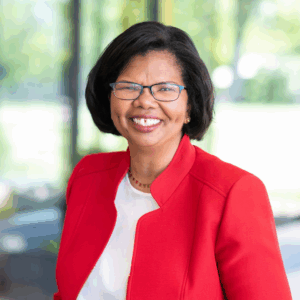
Dale Anglin, Press Forward
As told to the team at the Local News 2036 project.
I’ve worked in a lot of different places in philanthropy — kids issues, community development, climate. I was at a foundation that did a little bit of everything, so you had to be a generalist. When I think back to all those different issues, certain things haven’t changed in 20 years. I can tell you what a kid needs in childcare from 20 years ago. The kid hasn’t changed too much. Can we provide it? Can we pay for it? Is it the right quality? Okay. But the fundamentals of what they need have not changed.
This industry? The fundamentals keep changing.
Even if today we were able to get $2 billion and save some local news outlets, tomorrow the tech will shift. The next day, the audience will want something delivered a little differently. The politics will affect the ownership and everything else. That is hard. It is like a moving target on different terrain, in different planes.
As you unpeel the onion of trying to work in this space, it gets more and more complicated. And that complication, frankly, makes it hard to raise money. When you’re trying to raise money, they want it to be simple—no matter who you’re trying to raise it from. Foundations, donors, even your regular audience. It’s hard to raise money for complex things. The arts is so beautiful, right? Just show me the thing, and I’ll give you the money for the pretty thing. Everyone will fund a kid. That’s so easy to understand. This is not easy to understand.
The scale of the problem is something I think we don’t fully grasp as a group of people who care about this issue. It takes a minute for it all to congeal in your head. When someone said we’ve lost more journalists—that journalism is like number three or four in terms of job losses in this country—we are at the same level as DVDs. When you hear it like that, you’re like, wait, what?
I’m looking for an example — if someone can find me one, I will take it — of an industry in our history that has been so fully in demise and actually been saved. Those industries go away. You don’t fix them. Something else replaces them.
We are doing something pretty unique — trying to revise it, keep it, because it’s gone away so much on the local level. That is damn hard. And I don’t think everyone understands that that’s what we’re doing.
What can the Local News 2036 project do? You don’t fix a problem alone. To address any particularly complex issue, you need common information, common facts, some challenging of assumptions, and hopefully some sense of where you might want to go. Otherwise you’re all traveling on different roads.
This helps form the base of a next level of conversation. Which scenario do we think is going to happen? It’s probably going to be a mixture. How are we doing both a defensive and an offensive strategy? Right now we’re always on the defense, but most things get solved through offense eventually.
This type of gathering of information and narrowing down to some sets of assumptions starts the conversation for the next few years. You’ve almost produced a new language, but then you got to test out that new language. My question is: What are the activities to try to defend? Which do we make happen? I hope this conversation helps to get us closer to those answers.
Dale Anglin is the inaugural executive director of Press Forward.