
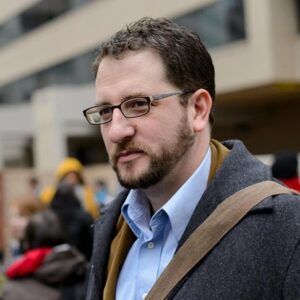
Craig Aaron, Free Press
As told to the team at the Local News 2036 project.
What’s really important as we think ten years out is: Where are we grounding this conversation? What’s the goal?
We’ve been through a long period where big media company profits have been the goal, and sometimes good journalism was a byproduct. We see what that produces — especially as we enter another wave of extreme concentration and consolidation where keeping people informed isn’t the priority.
We have this opportunity to reset around actual community needs. Everything we’ve been told was inevitable, that there was no alternative — those efforts have been terrible failures. They’ve harmed people. So maybe as we near rock bottom of that experiment, we have this opening to reimagine things we’ve been told could never work by the people who were breaking everything. I’m not sure we need to listen to them anymore.
I would love to host a Local News 2036 session with Free Press staff and board. The approach really helps get us away from what’s right in front of our faces and to consider new approaches and possibilities. We need to be thinking not just about how to respond to breaking news and everything that’s falling apart, but what and who it will take to reconstruct this field in ways that actually meet the needs of local communities. The scenarios help get me thinking outside of my usual silos and beyond my regular talking points to think more creatively about what’s possible. What I’ve liked about these Local News 2036 sessions is they’ve pushed us all out of the day-to-day and our usual talking points.
There’s an inherent skepticism that makes a good journalist, but it often makes journalists really bad at imagining how things could be different. And people trying to do good local work have been kicked in the teeth for years. When things are collapsing around you, it’s really hard to be creative.
It’s all about collaboration — very different from consolidation. Our goal shouldn’t be to paste together broken pieces of what we used to have. It’s gotta be a much more collaborative project that leaves room for experimentation and failure.
Whatever comes next has to come out of community engagement and community need.
We haven’t solved distribution. We’ve wasted time building on the backs of social media companies that are frankly against this project.
When it comes to core information you need to participate in democracy, I haven’t seen for-profit models that provide that. If we don’t significantly reinvest in public media and non-commercial solutions, we won’t succeed.
When it comes to policy, we too often start from the compromised position and try to negotiate our way up, instead of really asking for what we want. People who care about policy in this space have often already negotiated against themselves from the start. To move really transformative policies, we’re going to have to build champions and get people excited about solving big problems.
Craig Aaron is the president and co-CEO of Free Press and Free Press Action.