
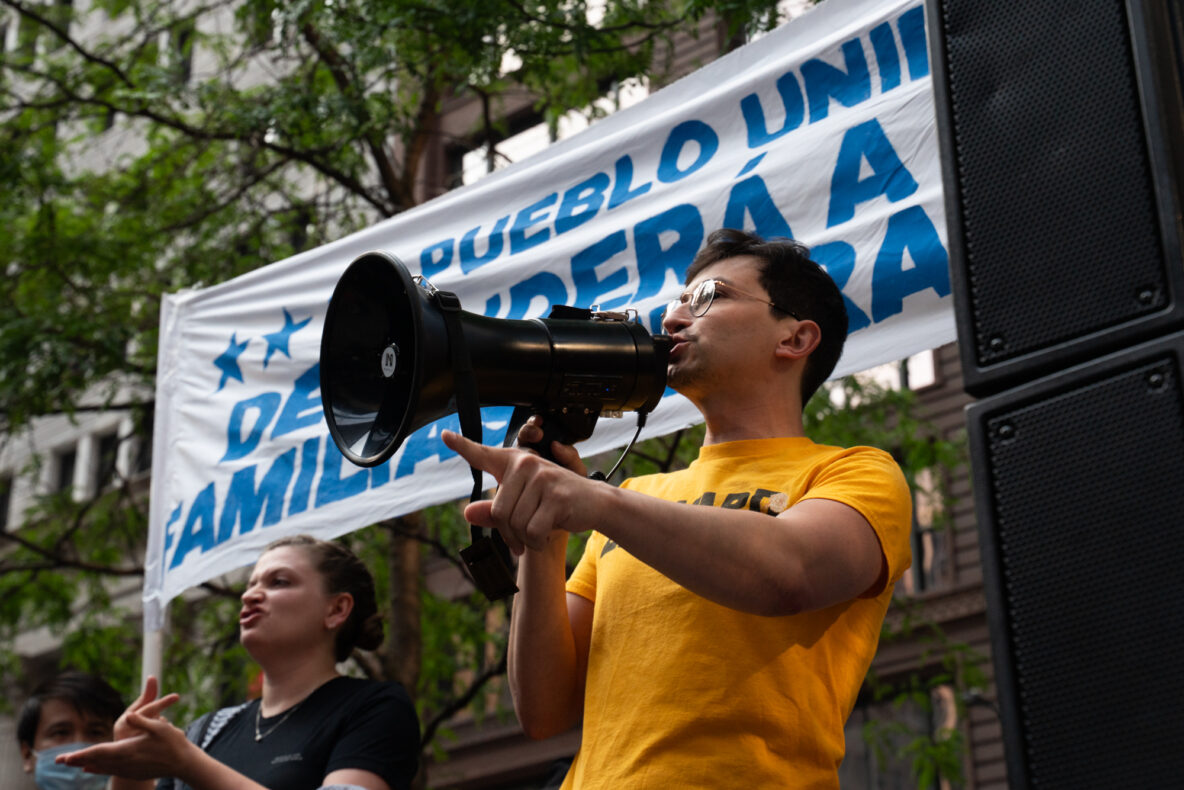
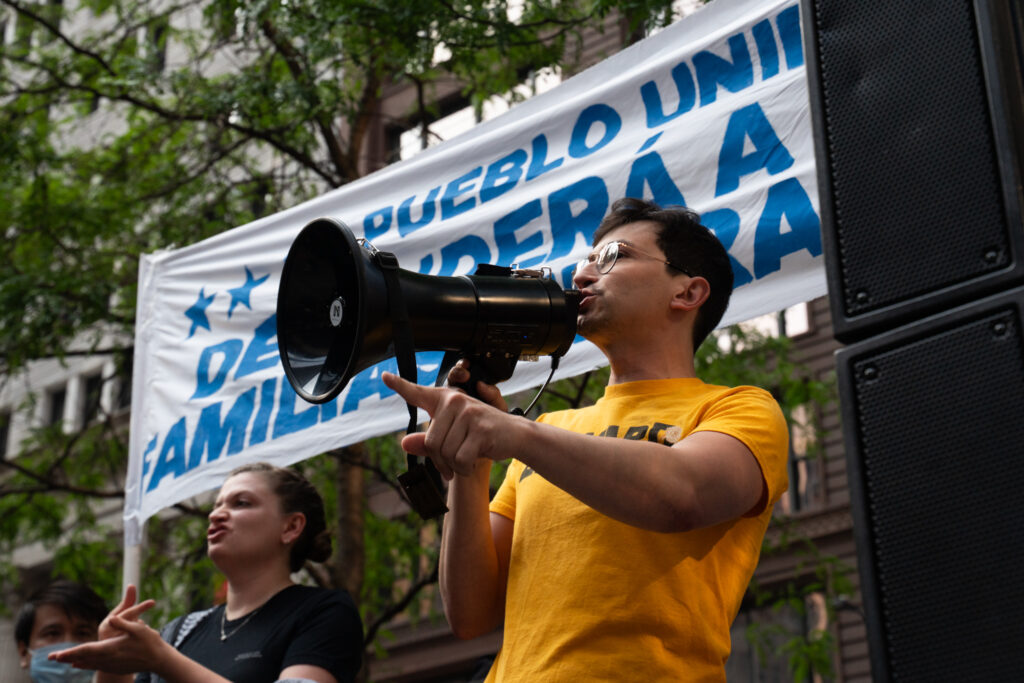
Organizer Diego Morales speaks at a rally before taking to the streets to protest ICE. Image by Camilla Forte for Borderless Magazine
When Tracy Baim first began talking with funders about support for immigration coverage in Chicago, she had no way of knowing how quickly the need would become urgent.
After starting her role as executive director of Press Forward Chicago in January 2025, Baim began conversations with the Walder Foundation and the Joyce Foundation about expanding support for immigration reporting. She soon followed up with a formal letter inviting additional funders to partner with the chapter to raise $500,000 to $1 million in new funding for expanded coverage.
The response was enthusiastic. Ten foundations stepped forward, including two that had never before funded journalism: Schreiber Philanthropy and the Illinois Immigration Funder Collaborative.
For many foundations, supporting local news is new territory — and can sometimes feel murky. Immigration, however, offered a clearer entry point: a way to invest in trusted information through an issue funders already understood and cared about.
That framing made a meaningful difference, said Adele Nandan, director of donor engagement at The Chicago Community Trust, which houses Press Forward Chicago. It allowed the chapter to connect with donors who were already deeply concerned about immigration in Chicago and invite them to see local news as part of the solution.
“We know a handful of donors that are really interested in what’s happening with immigration here in Chicago,” Nandan explained. “It’s great to be able to say, well, if we’re able to bring this to light through Press Forward, then more people can become aware of what is happening in Chicago, and more solutions can come to play.”
The approach, she added, opened doors to funders the chapter might not have otherwise considered — including some who realized for the first time that supporting journalism could advance the causes they already cared about.
With funder support secured, Press Forward Chicago invited a group of news outlets to submit a Letter of Intent to receive funding. Once again, the response was swift.
A rapid response in a critical moment
On September 10, Press Forward Chicago announced that 11 organizations would receive a total of $686,500 to support expanded immigration reporting and increased audience engagement.
That same week, the Trump administration launched an Immigration and Customs Enforcement (ICE) operation in Chicago, known as “Operation Midway Blitz.” Amid heightened ICE and Customs Border Patrol activity, immigrant communities faced mounting fear, uncertainty, and violence. Newsrooms reported raids, detentions, and family separations — while immigrant journalists risked their own safety as they continued reporting on events in their own neighborhoods.
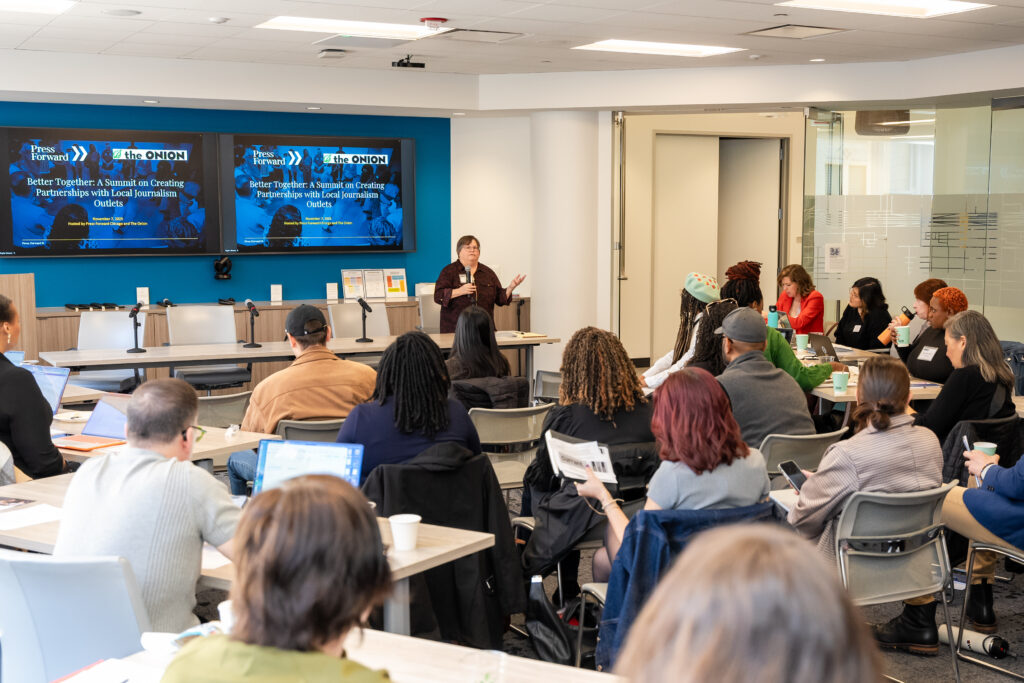
Tracy Baim speaks at a Press Forward Chicago convening of journalists and creators/influencers. Photo by Jamel Williams
The timing, Baim noted, was coincidental. “The way this funding happened organically was amazing and timed unbelievably — and sadly — well.”
As conditions intensified, Press Forward Chicago moved quickly to expand the effort, unlocking an additional $220,000 for three more news organizations — totaling $906,500 in immigration coverage support for 14 Chicago-based outlets.
The rapid response stood out in a sector known for moving slowly. “It’s a credit to our local philanthropic community that we were able to move faster,” said Taylor Moore, program specialist for Press Forward Chicago.
What the funding made possible
Collectively, the funded projects span neighborhoods, languages, formats, and communities across Chicago. Newsrooms have used the support to hire full-time immigration reporters and editors, partner with freelancers with deep community ties, expand translation and multilingual publishing, and invest in audio and visual storytelling.
Block Club Chicago documented how “Operation Midway Blitz” reshaped daily life across the city, grounding national immigration policy in neighborhood-level reporting. At Borderless Magazine, aligned funding from the Joyce Foundation and Field Foundation made it possible to build out a dedicated visuals team, resulting in richer photo-driven storytelling — including a cross-border portrait of two Chicago brothers reconnecting with the Guatemalan skate community. Cicero Independiente used its support to hire a full-time youth and schools reporter, expanding coverage in a majority-Latino suburb that has been among the communities most directly impacted by ICE activity. And on the airwaves, Lumpen Radio produced 10 new episodes of Boletín Migrante, delivering timely, accessible immigration reporting and resources to Spanish-speaking audiences.
Press Forward Chicago also awarded a grant to Chicago Public Media to launch an immigration reporting hub designed to amplify coverage across the city. The hub will support training and collaboration among outlets, including WBEZ, the Chicago Sun-Times, La Voz Chicago, and other community newsrooms, helping ensure critical reporting reaches immigrant communities in multiple languages and formats.
“Nothing like that has been done before,” said Moore. “It’s exciting to see this new model for collaboration. It’s an opportunity for newsrooms to reach greater audiences and for audiences to connect with community outlets they might not have heard of.”
“I think you lose out when you don’t have these small community and ethnic media outlets participating,” said Baim. “There is an absolute two-way street now between small and big outlets. When only one gets the resources and the others can’t compete for salaries, then it becomes a one-way street. We need to make it more holistic.”
Next up: Education
For Baim, bringing new funders into local news was one of the biggest wins of her first year as executive director. “Getting a new funder into journalism because of a topic they might care about is really rewarding,” she said. “It’s the most important thing that we can do, because the existing journalism funders can’t do this alone.”
Building on the success of the immigration initiative, Press Forward Chicago is now preparing to apply the same approach to another urgent issue: education. With Chicago set to hold its first-ever citywide school board election in November — all 20 seats on the ballot at once — the chapter sees a critical need for sustained, in-depth education reporting.
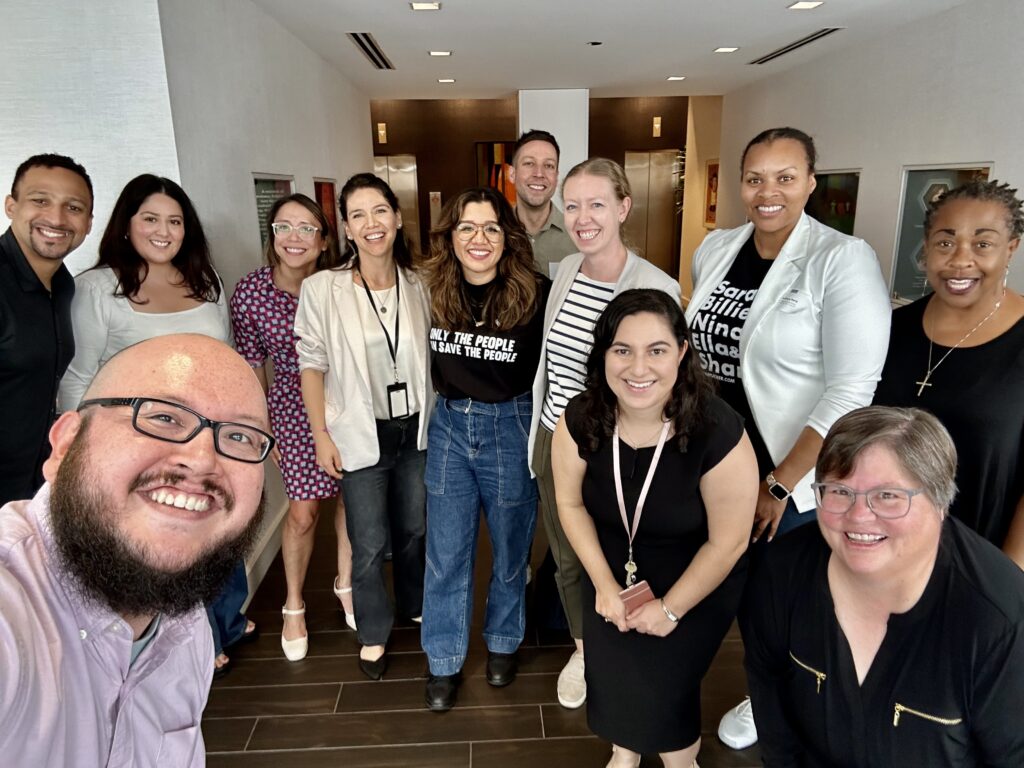
Press Forward Chicago funders gather at a quarterly meeting. Photo by Michael Venegas.
Press Forward Chicago has already secured $500,000 per year for three years to support education journalism, with ambitions to raise significantly more. Unlike the immigration initiative, which was designed as an emergency response, the education effort is structured as a long-term commitment — one that gives newsrooms the stability they need to hire staff, build collaborations, and provide consistent coverage across the education landscape.
The initiative, in collaboration with the nonprofit education news organization Chalkbeat, is expected to launch soon. For Baim and her team, it represents both a continuation of what worked and a vision of what’s possible when philanthropy meets the moment with urgency and trust.
“You can feel very paralyzed in moments like this,” Baim said. “But if you feel like you can shine a light on it — give money to those who are shining a light on it — it absolutely gives you purpose.”
Katie Hawkins-Gaar is a freelance writer and journalism consultant. She previously worked at CNN and the Poynter Institute and now works with a variety of journalism support organizations, including Press Forward, the News Revenue Hub, and Report for America. She lives in Atlanta with her family.