
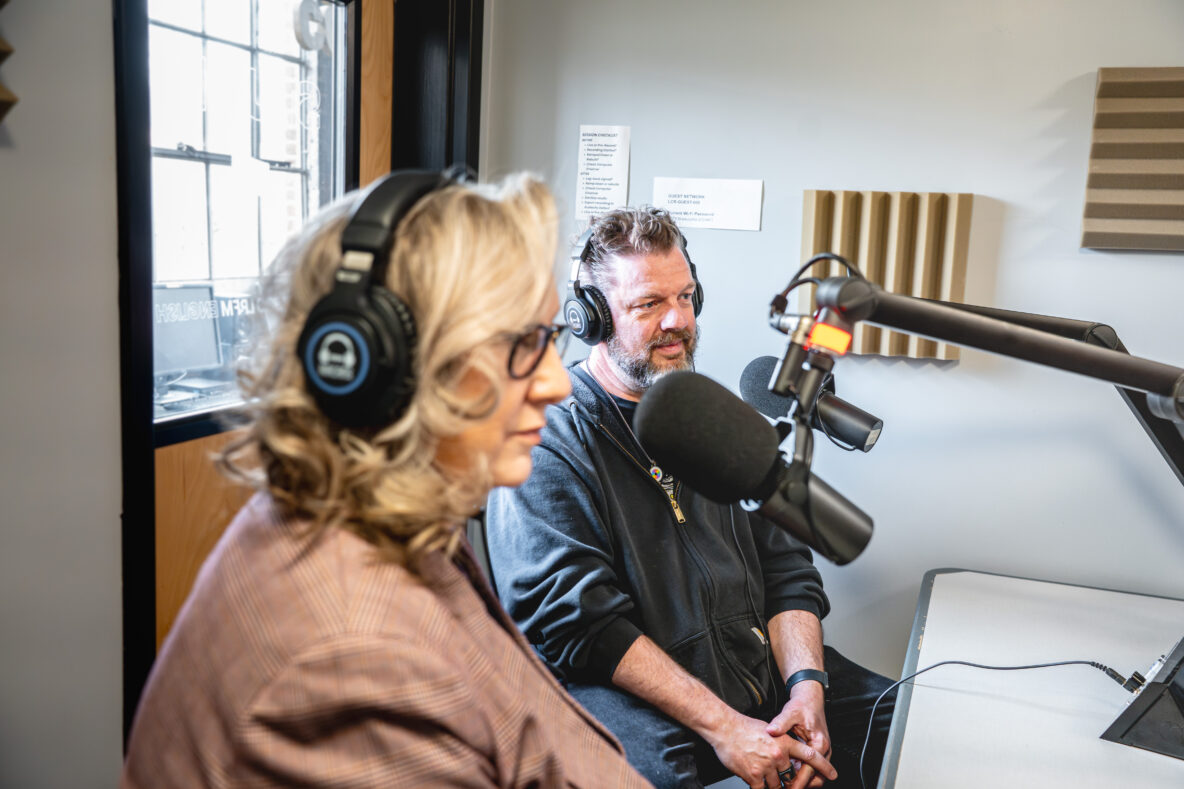
Melissa Newman of Press Forward Blue Grass and Mark Royse of MediaLex recording the DoGood Radio Hour podcast (Photo by Kasey Ogle Photography)
A new partnership between Press Forward Blue Grass and Report for America is betting that the future of rural journalism lies not in recruiting outsiders, but in equipping local residents with the skills to report on their own communities. Report for America has traditionally recruited early career journalists to become reporter “corps members” who are placed in newsrooms around the country. This new pilot program could change that equation by training community members to work as journalists in their hometowns.
The goal is to identify trusted community members and give them the reporting skills to thrive in local newsrooms. The program is designed as a research-driven pilot, using qualitative feedback and performance measures to evaluate its effectiveness in improving reporting quality, building trust, and supporting long-term sustainability in local news.
Melissa Newman, executive director of Press Forward Blue Grass, developed the training program from her experience as a publisher at rural newspapers and a professor teaching journalism classes.
“This pilot recognizes that the future of local journalism depends not only on professional training, but on belonging,” Newman said. “When reporters are rooted in the communities they serve, trust grows, and so does the likelihood they will stay and build long-term impact.”
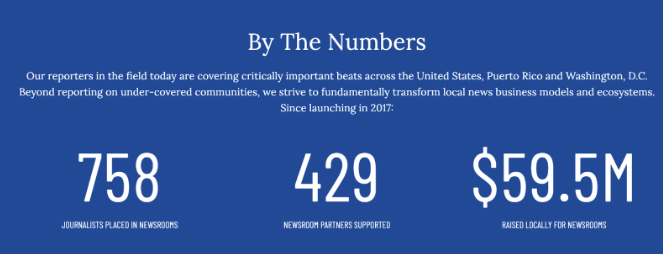
A graphic showing the impact that Report for America has had since 2017
Report for America, meanwhile, has sometimes struggled to fill reporter corps slots at rural newsrooms, and keep them in the community for up to three years. Kim Kleman, the organization’s executive director, says this pilot program addresses that issue by training people who already live there.
“Can we teach them journalism so that they’re there, they’re trusted, they’re doing good work and they want to stay? That could be game changing for Report for America,” Kleman said.
How it works
The program combines a rigorous, place-based curriculum covering media law, sourcing, and reporting with hands-on newsroom experience, allowing fellows to apply what they learn in real time. The training is intentionally deep and structured, and emphasizes foundational journalism skills alongside community awareness.
The pilot began in March 2026, with three community members taking courses on media law and ethics, quoting sources and cultural competency. They will continue taking courses on grammar and AP style, editing and proofing, news reporting and feature reporting, culminating in a capstone project. Newman says they take the eight-week classes online while having a virtual meeting with her for one hour each week to go over assignments. Once they begin work as corps members in July, each will participate in the usual Report for America training throughout their years in the newsrooms.
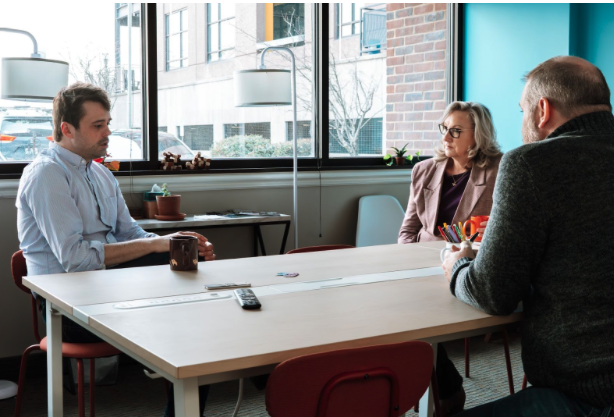
Pictured left to right: Richard Young, executive director of CivicLex; Dr. Melissa Newman of Press Forward Blue Grass; and Jason Blakeney, director of corps and newsroom excellence for Report for America. (Photo by Kasey Ogle Photography)
Press Forward Blue Grass will help cover half the newsroom’s salary requirement for a reporter from Report for America, as well as $3,000 per reporter to cover benefits. The three newsroom hosts offer differing experiences for corps members:
- MediaLex is a long-time community radio station (formerly called RadioLex) that is becoming a multi-platform, multi-lingual newsroom.
- CivicLex is a civic information provider focused on local government accountability, decision-making and civic engagement.
- The Woodford Sun is a rural family-owned newspaper, started in 1869, modernizing its digital presence while maintaining traditional local journalism.
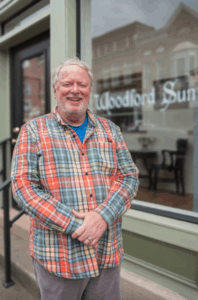
Scott White is the corps member working at the Woodford Sun. He had worked part time for the Sun for the past several years, but was never formally trained as a journalist. The pilot program is giving him the chance to grow into the full-time reporter he wants to become and that the Sun needs. (Photo by Kasey Ogle Photography)
Newman liked the diverse outlets that are taking part in the pilot. “Those three are very different, which I feel like sets itself up well for a pilot,” she said. “It feels like we’re really attacking it from all sides, in a rural place, with city and county coverage, and in a multilingual atmosphere.”
MediaLex plans to have its corps member cover the public health beat, whether it’s “someone finding a rabid skunk or if someone at a school got the measles,” said Mark Royse, general manager of MediaLex on a recent podcast. Royse believes this addition to the staff will help as they transition from community radio to podcasts, video and digital storytelling.
“This gives us a chance to establish consistent news that people need in a structured, best-practices basis,” he said. “This pilot is part of a bigger project of setting up our newsroom for success.”
For CivicLex, the program fits with their mission around civic education, which includes workshops for the public, where they’ve seen people become very sophisticated in understanding local issues, according to Richard Young, the publication’s executive director.
“No doubt, having a corps member will expand our ability to cover topics that our audience have told us are important to them, but I’m excited to see how his unique perspective and experiences will shift the rest of our work,” Young said. “We’re all so deep down the rabbit hole of local government and policy, that I expect having an outside perspective will help us provide information in a way that’s more accessible, particularly to younger folks in our city.”
Expanding the pilot around the country
Once the pilot is complete, there’s potential to increase the number of corps members in Kentucky and across the nation. Report for America’s Kleman says this program could be replicable in other regions. A major goal of the program is to strengthen local news ecosystems nationwide, especially in underserved rural communities.
“I have every intention that this is going to be a real success,” Kleman said. “There are so many other parts of the country that need trusted journalists in their communities to do local news.”
But before the program can expand, more local partners will need to be identified, including at community colleges. The reality is that Melissa Newman can’t teach all the new corps members. In fact, Newman says that she considers the training as being place-based, with the necessity of having someone with local knowledge leading it.
“The best case scenario is that you take the curriculum, with its foundations of journalism, and hold it to fidelity,” said Newman. “And find someone in your community who will be teaching these courses — it could be a retired journalism professor or somebody in the community who can teach them the way they’re meant to be taught.”
Ultimately, this pilot program is testing a simple but powerful idea: that the people best positioned to tell a community’s stories are the ones who already live there. By investing in local residents rather than importing talent, Press Forward Blue Grass and Report for America are not only addressing staffing challenges in rural newsrooms, but also rebuilding the trust and connection that local journalism depends on.
Mark Glaser is a communications consultant for Press Forward, The Lenfest Institute and Tiny News Collective and was the founder and executive editor of MediaShift.org. He was formerly the director of business and program development for the New Mexico Local News Fund. He runs the Wind Power Media consultancy out of Santa Fe.