

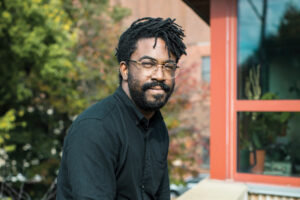
Darryl Holliday, Commoner Company
As told to the team at the Local News 2036 project.
There are threats to all of us right now — whether we’re TV or newspaper or nonprofit — and we have to recognize that these threats threaten us all, even if we’re in different parts of the field.
Big tech companies and federal government actors who do not want to see public media or service journalism exist are taking antagonistic positions, and they already have the power. The Corporation for Public Broadcasting represented a commitment to publicly funded, service-oriented media—a part of the American civic project that goes to the foundation of how we govern ourselves—and it does not exist anymore. It’s now clear that if we cast off any part of the local news field we’re basically feeding them to the wolves, because they’re going to get trampled by hedge funds, hostile legislation and social media platforms.
Any intergroup debates that we have internally are worthwhile, to the extent that we’re challenging each other, refining and strengthening our arguments and finding alignment. We’ve been doing that push-and-pull for the last 15 years, and we’ve learned a lot—but now it’s time to come together, more unified and better equipped to protect and expand the value of the work that we do.
The three scenarios we’ve developed for this Local News 2036 project, in some ways, represent the dominant theories of change in the local news and information field. The first is where commerce dominates our decision-making processes. The second is if we don’t do anything and only have incremental change—a lack of decision, but still a decision; and one that will bring about the collapse scenario fastest. The third is: What if we embrace this moment and invest in reimagining the purpose and outcomes of local news?
My preferred scenario is scenario three—treating this moment not as the demise of a tradition, but the start of a new one. That’s what’s going to rally people and bring the next generation into our field with excitement. We need to offer a bigger, better, more strategic way of thinking about what local news can do.
That’s the thing about scenario three that gets me excited—and I already see it, both across the U.S. and around the world. A new journalism identity is forming around new practices, but I fear we’re in a moment now where that vision could get stamped out if we retreat to business as usual.
So, again, it’s a question of ideals and outcomes. Do you really want to sell newspapers? Do you want more people voting and running for local offices? Do you want more clicks on your web ad? Do you want a stronger civic society? What outcomes do you really want at the end of the day?
If all you want is to sell information to people—or sell peoples’ information—I am not with you; I’m working on a fundamentally different project. But if you’re saying, “I know I can improve people’s material lives, and one way to do that is by putting out a high-quality newspaper,” then we’ve got common ground. It can be “both/and”: local news providers need to know how to run a business and we need the right mix of public financing, cooperative structures and philanthropic support that understands local news as the merit good that it is. We can build a powerful and strategic way of sustaining this work where everyone has a role to play. That’s how we unify.
At the upcoming 2026 News Futures Convention I’m planning to use these scenarios to facilitate a conversation that helps our constituents—the 650 people who have signed the News Futures charter—shape and select our 2026 Working Groups, and drive the next evolution of our work. The framework that the LN35 project put forward will help our group see what’s possible in new ways.
What I hope this project can do at-large is create a bigger alliance and find the areas of alignment we need to solve these existential challenges. In other words, if we let it, this project can open up space to assume good intent from each other and imagine, together, what we fundamentally agree on. Ideally, we arrive at a theory of change that has meaningful importance in people’s lives and gives the public a reason to support, join and advocate for our work.
Darryl Holliday is the co-founder of Commoner Company.