
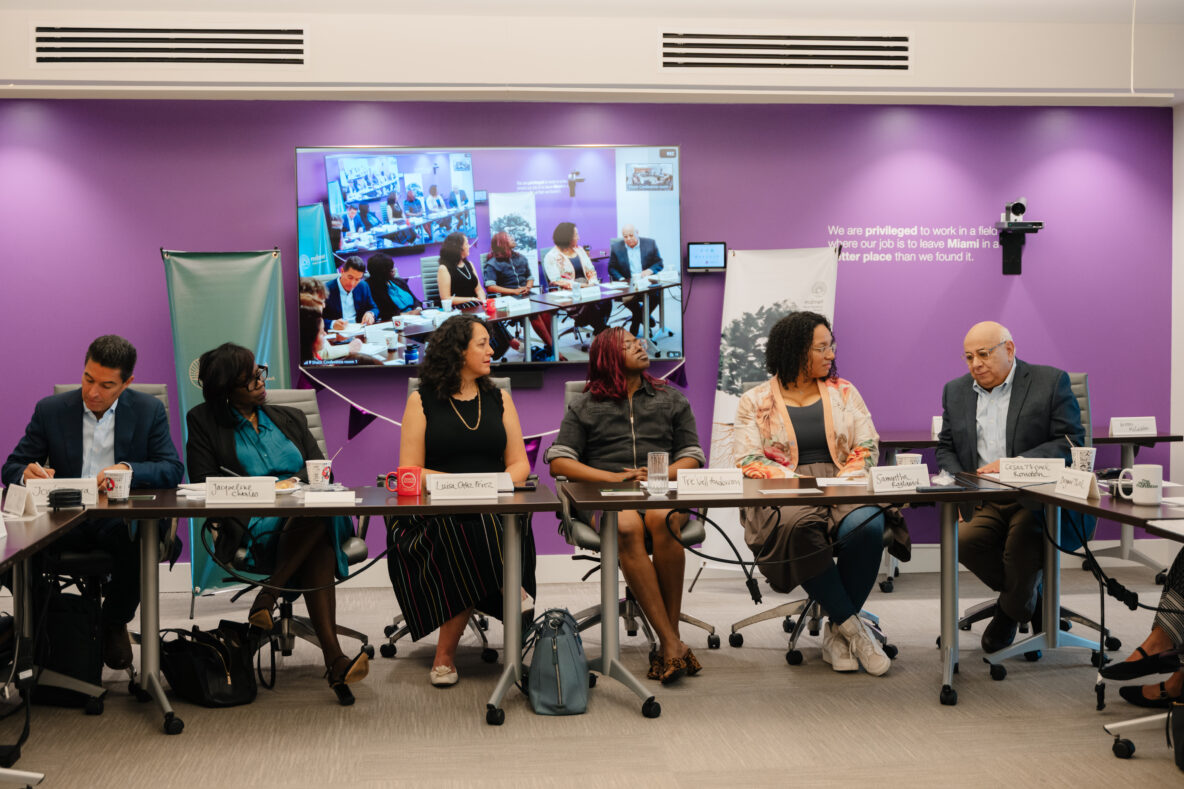
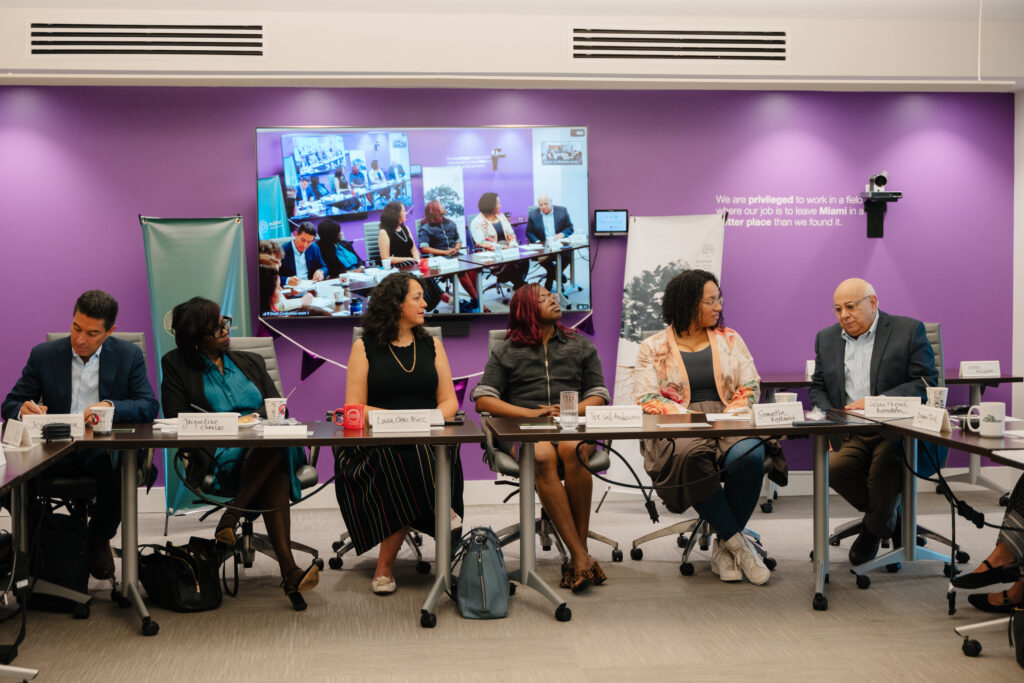
MDRNet launched ahead of the Knight Media Forum. Pictured are (left to right): José Zamora, Committee to Protect Journalists (CPJ); Jacqueline Charles, Miami Herald; Luisa Ortiz Pérez, Vita Activa; Tre’vell Anderson, Trans Journalists Association (TJA); Samantha Ragland, American Press Institute (API) and César Miguel Rondón, En Conexión. Photo by Natalia Algarín.
The Media Resilience Network (MDRNet) is a newly launched initiative from Vita Activa designed to provide free, confidential mental health and peer support to journalists, especially those from underrepresented communities and newsrooms under strain. Offering one-on-one peer support, culturally attuned coaching and counseling, crisis and harm reduction services, and tailored “Task Force” assistance for local newsrooms, MDRNet (nicknamed “MotherNet”) aims to meet journalists at moments of emotional distress, professional doubt and physical risk. Operating via secure platforms like Signal and staffed beyond traditional business hours, the network emphasizes safety, trust and accessibility at a time when many reporters feel exposed and unsupported.
The launch comes amid alarming findings: 80% of surveyed journalists reported burnout or chronic stress in the past year, and just 2.5% described their mental health as excellent. According to Luisa Ortiz Pérez, executive director of Vita Activa, the crisis stems from relentless news cycles, shrinking newsroom resources, the rise of AI-driven workloads, disinformation and growing mistrust from both the public and within news organizations. Ortiz argues that mental health is not a luxury but essential infrastructure for journalism and democracy. By professionalizing care that has historically happened informally among peers, MDRNet seeks to help journalists stay grounded, safe and connected so they can continue doing the work that keeps communities informed.
Vita Activa received an infrastructure grant from Press Forward last year. This Q&A is lightly edited from a recent conversation with Ortiz after MDRNet’s launch ahead of the Knight Media Forum.
How did you personally get into this work?

Luisa Ortiz Pérez
Luisa Ortiz Pérez: It was a very rude awakening from tech optimism to tech realism. I realized that as a journalist, technology was moving us away from the work that we wanted to do. It was clickbait. It was online harassment. There was division in the country that made me think that there was a need for people to talk to folks who were qualified.
So during the pandemic, I went to nursing school. I went to the Johns Hopkins School of Public Health and I trained. And I’ve been training folks on mental health awareness and tactics ever since. But it is about realizing that we mostly do this at a kitchen table.
We grab a cup of coffee. We talk to each other. But it is possible to professionalize this kind of work.
Why do you think mental health is so important for our field?
Ortiz: I don’t think it’s important. I think it’s essential. For many, many years, we recognized and gave awards to people’s creative spirit. So you would get an award, you get a Pulitzer because you did research, you get more money because you’re great at your job. What makes you great at your job is your brain and your eyes and your ears. And those are your tools of work.
But if you’re not stable, if you’re not centered, if you’re not healthy, your tools are affected. Not connected. And that is why historically, journalists self-medicate. Historically, journalists have the worst health that we can ever imagine. We lose our relationships, the rate of divorce, the rate of estrangement with loved ones.
It is not necessary. And the younger generations are saying, ‘if that’s what it’s going to be, I don’t want to stay. I don’t want to do this job.’ So today, [mental health] is an essential brick in the wall of that which sustains our democracy, but also that sustains our profession.
Tell us about MDRnet, its key aspects and why you think it’s needed.
Ortiz: MDRnet is a space where journalists will find help, journalists from underrepresented communities, in spaces where local news is at risk, as well as in places where they require support during moments of crisis, moments of emotional challenge, moments of professional doubt.
Our services are confidential, they can be anonymized, and they are free of charge. That is super, super important. We are providing one-on-one peer support, crisis control, and crisis and harm reduction. We are providing coaching and counseling with experts who are trained and also are culturally attuned to what the journalist requires, as well as where the journalist is from.
And we’re about to launch our Task Force program for local news desks, small organizations, people who require a longer conversation and a more designed-to-their-needs program. We’re really, really joyful in a time where joy is not necessarily an easy thing, but we’re trying to bring a little more joy and care to the space.
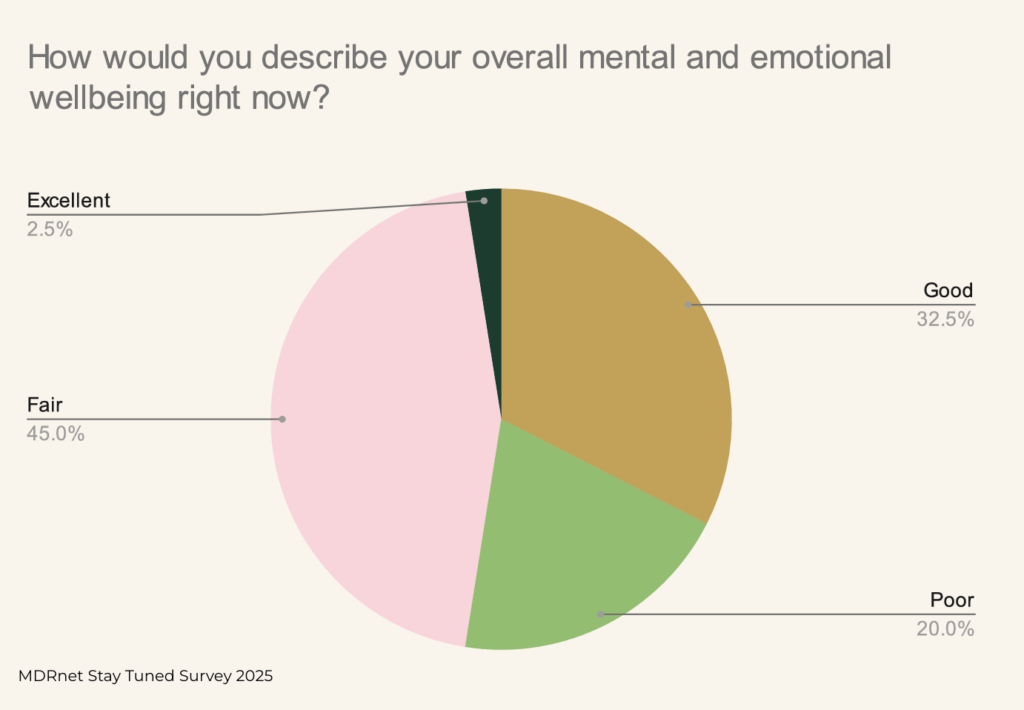
MDRNet survey results
Your survey results are pretty stunning about the rates of burnout in the field. What do you think this says about the field?
Ortiz: People are burned out because they do everything. So after tons of layoffs, as well as automating almost everything in the newsroom, that means that the journalist has to be a jack-of-all-trades. And being a jack-of-all-trades already takes a toll on the body. The current context doesn’t avail itself for people to actually take a break. It has been nonstop.
Flooding the zone with constant news is also a tactic to make people not be able to focus. As a helpline, we also are very, very understanding of the adverse effects of AI in mental health. Apparently, it makes work faster, but it makes you work longer in trying to course correct and trying to prevent mistakes from material that you haven’t created.
What we see is absolute devastation, especially in places where ICE is conducting raids and they have to cover that. Climate anxiety is through the roof. It’s a constant demand of super-human abilities to process reality so that you’re able to share it with others, compounded with something that is absolutely dramatic. And that is disinformation. You are not trusted. And that is really what is breaking us. Disinformation, misinformation, plastic content generated by machines — that is the real adversary.
And journalists are dealing with a lack of trust now from the public and their news organizations?
Ortiz: They are distrusted in the place where they work. They don’t feel they have their back, they don’t feel they’re supported, and they don’t feel they will have their back when push comes to shove. So a lack of support, lack of understanding, they feel they have a target on their backs. And they are afraid for their physical safety. We have worked globally, we work with people everywhere on the planet, and we have never felt the imminent danger the way it’s coming through the helpline now.
On top of that is mistrust from the public, so the question is why stay? And we give an ounce of hope, we give an ounce of joy, we give a sprinkle of it. ‘What you’re doing is essential. It’s essential for democracy, and you’re a great human being, and we love you very much, and we want you to stay.’ It is going to be an uphill battle to keep journalists safe, and to keep them trusting, and to keep them okay.
Are there things that reporters and editors can do to prepare themselves or strengthen themselves in advance, before they feel overwhelmed or a crisis hits?
Ortiz: Yes, I think that preparedness is going to be essential. One needs to prepare the brain the same way we prepare our backpack before going out to coverage. How do you prepare your brain? How do you establish limits with yourself? How do you establish limits with your editor? What kind of physical regime are you establishing so that you’re able to withstand? What kind of protections?
People are going out in the field with bulletproof vests now and helmets. They’re heavy. And if it’s hot, it’s even worse. So we are talking about physically preparing yourself like an Olympic athlete so when you’re out in the field, you are ready. During our lunch at KMF, Jacqueline Charles, reporter at the Miami Herald, covering immigrant communities in Florida, tells us that she has specifically made agreements to make sure that she is well and she can continue to do her work.
Cesar Miguel Rondón covers Venezuela today from Florida because you cannot do journalism in Venezuela. And as a journalist in exile, he believes in the joy of dance as a way to prepare for coverage.
People are finding any kind of peace, and they’re holding on to that with a vengeance. People go out on runs, people go out on walks, people go in the water, people talk to their neighbors. There’s value in friendships with people who are not journalists, so that you’re reminded that the world is not the newsroom only.
How do you collaborate with journalism support organizations (JSOs) to amplify what you’re doing and your impact?
Ortiz: Well, we have a very healthy relationship with JSOs, we talk all the time. There is an underground railroad of conversations. All sorts of support organizations have Slack networks, and we’re constantly in conversation with people. WhatsApp is insane. We have channels, we have lists, we’re part of so many organizations and groups. Our journalist friends are a family, and they are supportive of us.
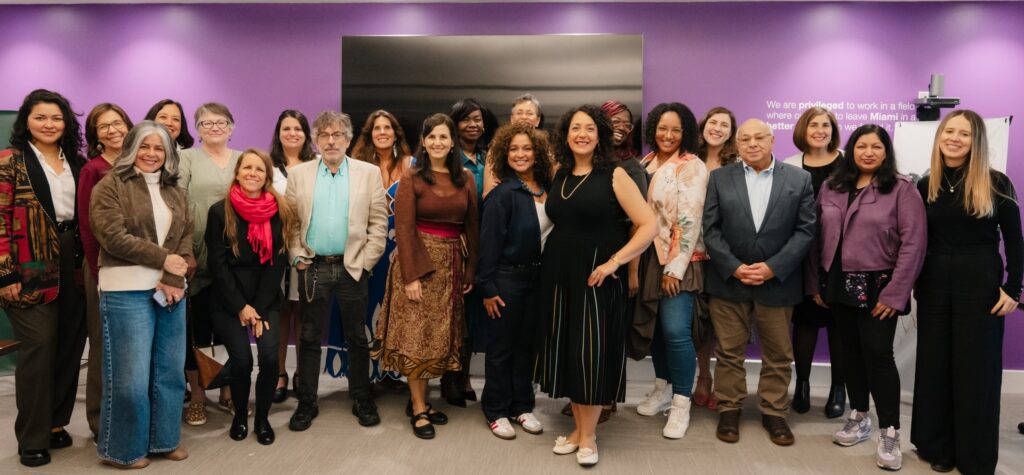
Attendees at MDRNet’s launch lunch ahead of KMF. Photo by Yhonnathan Roca.
During our lunch at KMF, we took a picture [above], and most of the people there we’ve known for the past 20 years, and they were there hugging us. It was so intense. It was so beautiful. I think that that’s what collaboration is — allyship. Collaboration is zero conflict. It’s sharing resources as well as information.
If you or someone you know needs crisis support feel free to contact mdrnet.org, via Signal on +973-626-7394 or email at hello@mdtnet.org.
Mark Glaser is a communications consultant for Press Forward, Knight Foundation, The Lenfest Institute and Tiny News Collective and was the founder and executive editor of MediaShift.org. He was formerly the director of business and program development for the New Mexico Local News Fund. He runs the Wind Power Media consultancy out of Santa Fe.