
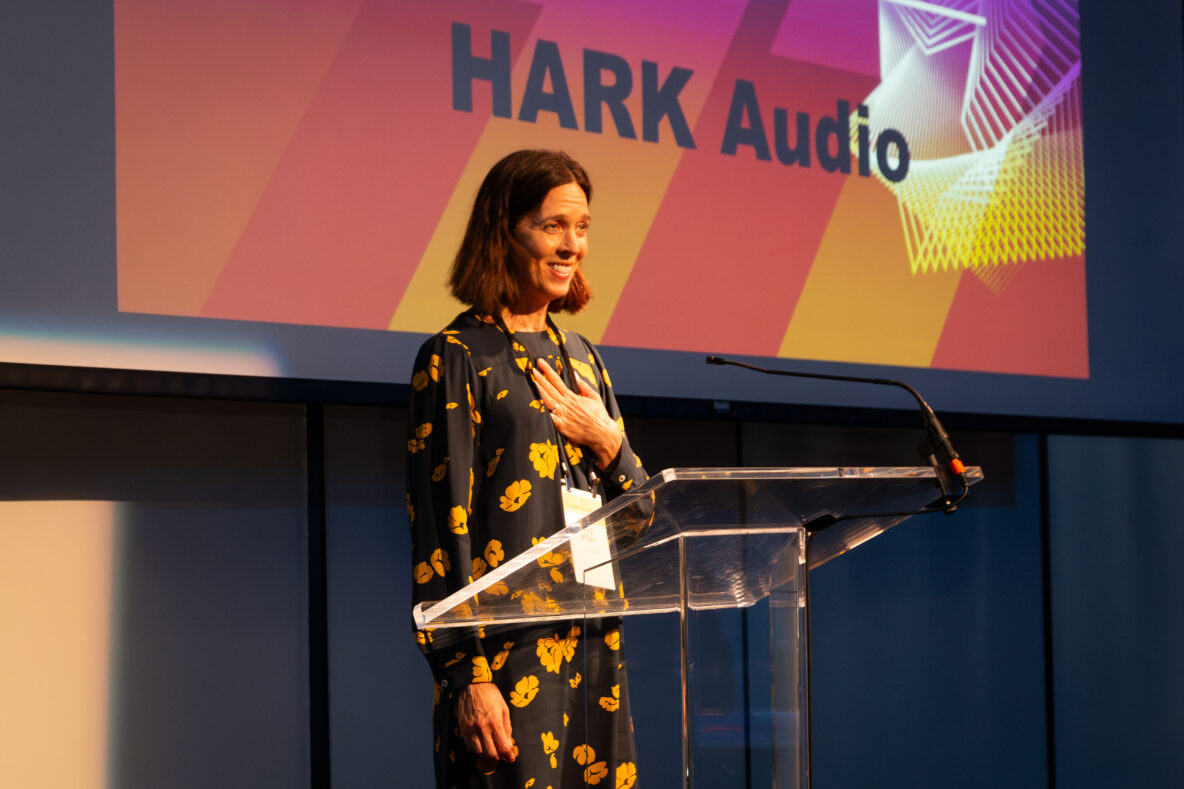
Hark Audio receives a 2024 Next Challenge award.
Case Study: Glen Nelson Center
Investing in early-stage startups to drive public media innovation.
Host Organization: American Public Media Group
Context / Starting Conditions
Glen Nelson Center was established by American Public Media Group (APMG) to formalize and scale the organization’s long-standing entrepreneurial culture and to support and scale innovation at APMG and throughout public media. Innovation at APMG had long been driven by individual teams and experiments, and the center was created to give that energy a more stable home – providing a durable structure for exploring new technologies, business models, and tools that could strengthen public media over the long term.
Initially conceived as a physical incubator space, the center evolved to focus on investing in a growing portfolio of technology companies through the Horizon Fund and identifying innovative new products through a national startup competition, the Next Challenge for Media and Journalism and a similar program for college students called College Emerging Voices. This shift allowed APMG to extend its impact beyond place-based experimentation and engage directly with the broader startup ecosystem, shaping the future of media and information.
Core Challenge
Traditional venture capital has largely bypassed media innovation, viewing journalism-related business models as capital-intensive, slow-growing, or difficult to monetize. At the same time, public media faced a strategic imperative to stay ahead of rapid technological change while diversifying revenue streams and reaching new and younger audiences. The challenge was twofold: how to access cutting-edge innovation that the market undervalued, and to do so in a way that generated real learning and strategic impact for the mission-driven media ecosystem.
Catalytic Intervention
Through the Horizon Fund, APMG makes minority equity investments in early-stage, for-profit startups whose products are clearly relevant to journalism and public media.
Crucially, the goal is not only financial return, but also a “strategic learning return.” Each investment is designed to generate insight for the field of public media about emerging technologies, evolving audience behaviors, or new operational tools while giving startups a real-world testing ground within an evolving media landscape.
Capital Types
The Horizon Fund deploys mission-aligned equity investments in early-stage startups, usually at the seed or pre-seed stage. This allows APMG to take ownership stakes and participate in long-term value creation and impact rather than limiting its role to short-term pilots or vendor relationships.
Jeff Freeland Nelson of the Glen Nelson Center announces the opening of the Next Challenge for Media & Journalism
Support Structures
Defining features of the model include the use of “Executive Champions” internal to APMG and a large and active advisory board. Glen Nelson Center’s advisors include community leaders, professional investors, and industry experts who meet to evaluate every investment opportunity.
Executive Champions are leaders within APMG but outside the venture team who are paired with portfolio companies. Executive Champions help startups pilot products, navigate newsroom workflows, and identify viable product-market fit within public media contexts.
This structure benefits both the investor and organization: startups gain access to informed, mission-aligned customers, while APMG teams engage directly with innovation rather than encountering it only after market maturity.
What This Enabled
To date, Glen Nelson Center has built a portfolio of 19 companies, many of which have gone on to raise additional capital at higher valuations. The venture approach also sparked internal innovation, leading to the creation of the Kling Innovation Grants – an internal program that applies similar venture principles to APMG newsroom teams experimenting with new formats, tools, and workflows. Together, these efforts have embedded innovation more deeply into APMG’s operating culture.
“The strategic impact of Glen Nelson Center is visible throughout APMG and public media,” said Barry Gisser, APMG’s CFO. “Far beyond just making investments, the Horizon Fund is helping us understand how media is changing and stepping up to better deliver on unmet audience needs”
Early Signals & Learnings
Early experience suggests that incorporating equity investments enables media organizations to move from passive supporters of innovation to active owners in the industry’s future. Rather than diluting mission, this approach demonstrates that venture investing can amplify mission-driven impact, allowing mission-driven organizations to participate in financial upside while staying closely engaged with the technologies and tools shaping the next generation of journalism.
Why This Matters for the Field
Glen Nelson Center challenges a common assumption that mission-driven institutions must rely exclusively on grants or procurement to engage with innovation and create impact. By using equity investments as a catalytic tool, APMG demonstrates that public-serving institutions can pursue impact through ownership – remaining engaged for the long haul and sharing in the upside when innovation succeeds.
For the broader media field, the model offers a powerful signal: public-serving media organizations can shape markets, not just react to them – and mission-aligned equity investing can be a strategic tool for doing so.