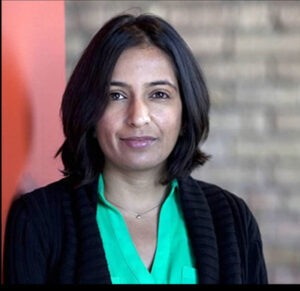
Angilee Shah, Charlottesville Tomorrow
As told to the team at the Local News 2036 project.
When I think about the three Local News 2036 scenarios — where commerce dominates, where there’s collapse, where the field reimagines its outcomes—I think the reimagined version and the very dystopian AI-driven commercial version are already here at the same time where I live. We’ve seen consolidation and a rapid decrease of independent journalism in Central Virginia. But we’ve also seen an amazing upswell of community leadership to help people get vital information, and a significant number of people contributing to build an alternative to news by algorithm.
I hesitate to commit to working toward a specific Local News 2036 scenario when understanding what communities actually need and want is still one of our biggest tasks. There is a danger in choosing the scenario you’re working toward without having a system to change course based on what you’re learning. For us at Charlottesville Tomorrow, the tipping point on moving from concept to action is when we have invested in community governance and evaluation systems — where community members’ needs and feedback guide what we’re building, before we begin proposing large investments. Otherwise the money will lead you rather than the needs.
That’s why, as we think about how we address the gaps in local news and information, it’s really important that we think about the transparency and governance of how we rebuild those systems. We have two basic modes — the nonprofit and public media sector and the commercial sector — and frankly, neither is broadly used to having community-based governance or community-led processes for building out our products and services. As an industry, we are not led by the people impacted most by the issues we cover. But that’s what we need if we want something that is durable for the long haul and will be of civic value to the communities we serve.
Building community governance will always be a work in progress, like our democracy itself. It means we have to think about how we’re making choices, and who gets to make the choices about investments. Is it the people most impacted by those investments, or is it people who are closest to the money? Or is it some combination of both?
At Charlottesville Tomorrow, we’re working toward more and more community governance for media in our area. And it’s not an easy lift.
This year, for Charlottesville Tomorrow’s 20th anniversary, we also are elevating community members’ vision in a series called Next 20. Next 20 began this fall and will run through January. Next 20 is about what our community wants for the next 20 years, in many sectors from housing to education to democracy, particularly because we’re in a moment right now where people feel quite stuck. So we wanted to give people a little bit of breathing space to say, “This moment isn’t going to last forever, so let’s be ready for the future.”
With our community and our board’s forward thinking, I think the Local News 2036 project is really quite parallel with what Charlottesville Tomorrow and our partners in Charlottesville Inclusive Media are working on. We’re trying to set ourselves up for a strong future.
What I’ve liked about the Local News 2036 conversations — and our Next 20 conversations is that they bring in people who usually aren’t in the most powerful rooms. The conversation is not just about the people who are running foundations or large donors or philanthropists, and not just people who are in the news and tech industries. Too often, the people making choices about the biggest investments are not the people most impacted by the decisions we all make. These scenarios and conversations are designed to bring in different perspectives, and I’m finding shared experiences with others who are working at the community level, too.
We have to really think about how we assess success, together. According to whose standards are we assessing progress toward our mission, and who gets to be the judge at the end?
If we can’t bring new perspectives into this work, we will fail. Bringing new people in—and spending time helping more people learn about this sector—can feel like it derails you if you are focused on a goal that you’ve already decided. But if we don’t allow our plans and mission to shift with the needs of local stakeholders, we’re going to be building local news that’s successful for the short term rather than the long term. You can put all the money you can muster into new products and capacity, but if nobody trusts it, what difference does it make?
Angilee Shah is CEO and Editor-in-Chief of Charlottesville Tomorrow.