

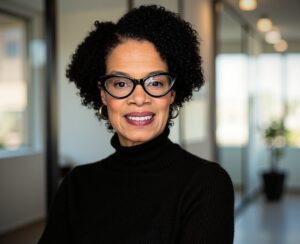
Kimberly Spencer, Director, Colorado Media Project
As told to the team at the Local News 2036 project.
The future I want to build is really defined by equity — a world where information is treated as civic infrastructure, ensuring everyone has access to the information that they need to navigate their lives. While we have made strides, since January, there has been an active effort to undo them. As discouraging as it is to see years of hard work undone, we must continue. The work is not finished and equity cannot just be a buzzword. It has to be a centerpiece, a main pillar of our infrastructure.
To me, equity is about power. Those that have access to it, have power.
Consider immigration: when people are actively being disappeared off the street, information on how to even navigate that reality is a matter of survival. It shouldn’t be a luxury hidden behind a paywall. We need a future where access to decision-making information is as fundamental as water and electricity.
We must also reconcile the harm that the media has perpetuated against people of color. We can’t pretend that past efforts were sufficient or that the work was too hard and simply move on. The harm is still happening. Some media outlets are complicit in our current polarization, because we have stopped holding power accountable. We cannot rebuild trust without repair.
What might prevent us from getting to a future rooted in equity and political accountability? Fragmentation. We’re going to have to reckon with what and who the media is. How do we define it? Right now, we are fragmented, often working in silos with local outlets and national outlets, working with little connective tissue between them. Add in non-traditional local news and information providers to the mix, that fragmentation only deepens, making it impossible to act as a unified ecosystem.
We’re also going to change how we invest in local news and information. We know that the business model for local news is broken, and understand the connection between the loss of local news and the impact on civic engagement, yet we have not figured out how to make investments that sustain local ecosystems. We have an opportunity to build a shared ecosystem where resources and power are distributed locally.
That is what excites me about the Local News 2036 project. It forces us to break out of the daily “survival loops” and engage in systems-level pattern recognition. Most of us are so deep in the crisis of now, that we rarely step back to design what’s next. This project demands that we look at the architecture of the system itself.
At the Colorado Media Project, I plan to use these scenarios to bring together our grantees, partners, and the larger ecosystem. Funders are often very stretched, news outlets are focused on the current moment and trying to fill gaps. This forces us to ask: Where are we headed, and what could we do differently with our portfolio or the capital we can deploy to get there?
I’m particularly excited about using this vision outlined in this project to access different types of capital that we haven’t tapped into before – social capital investments, for example. How do we start to access those different investments to build civic infrastructure? This project gives us the business case for it. What does this look like? Why is this important? This could be that roadmap to help us engage folks we haven’t engaged with before.
Finally, we have to solve the human capital crisis. We’re expecting news outlets to perform like they did 20 years ago, but with a fraction of the resources and amidst rising hostility. In Colorado, we have reporters facing death threats and physical attacks, all while being underpaid. We cannot ask the next generation to enter a field where they are expected to “save democracy” while living in poverty. If we don’t solve the economic viability of the job itself, there will be no one left to build this future.
Kimberly Spencer is director of Colorado Media Project, home to Press Forward Colorado.