
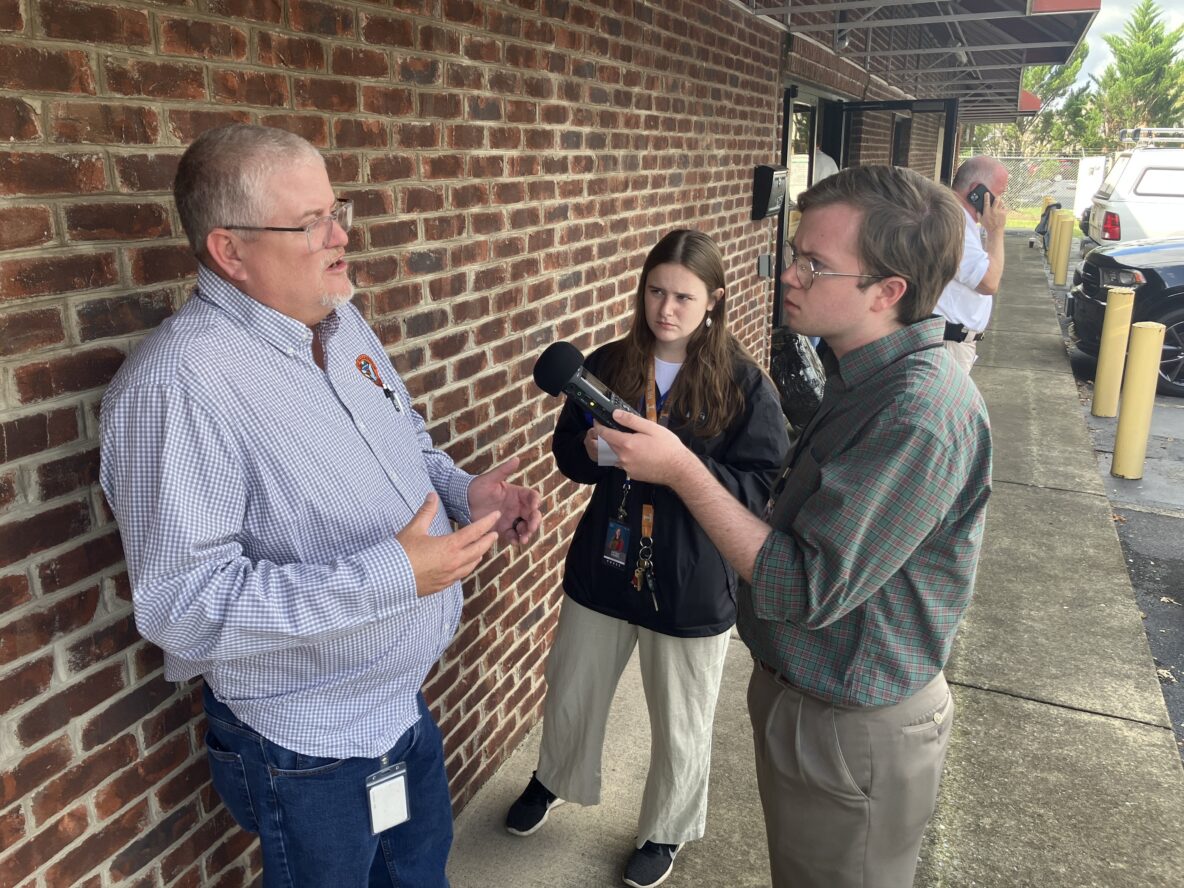
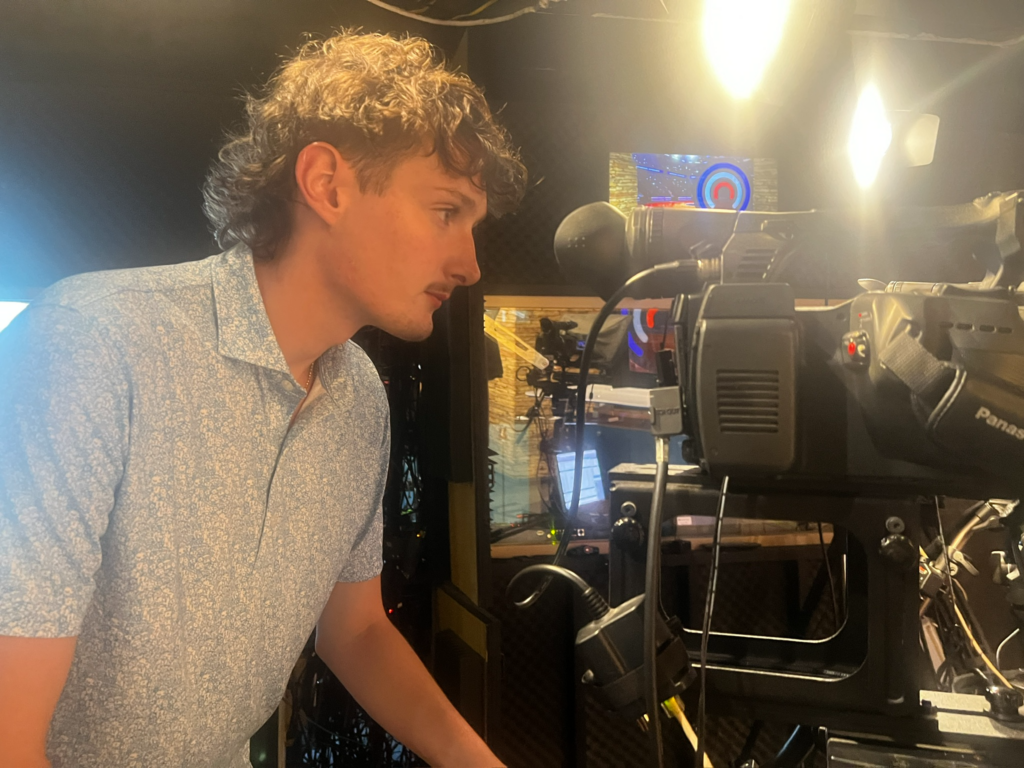
Thanks to a grant from Press Forward Central Appalachia, Mountain Top Media was able to hire new radio reporters such as Jackson Lucas, pictured above, to cover more rural areas (Photo courtesy of Mountain Top Media)
At the second Appalachian Big Ideas Festival in 2023 — which took place about a year after deadly flooding killed more than 44 people in Eastern Kentucky — funders, community members and journalists were discussing how much civic infrastructure the region lad lost. In the middle of that conversation, Eli Flournoy, a former CNN journalist and managing director of news business consultancy Media Growth Partners, stood up to say that he was helping put together a new Rural News Fund to support news and information in Central Appalachia, and by next year they would have $1 million committed to it.
Ryan Eller, executive director of the Appalachia Funders Network, said his reaction in that moment was that he “was going to have a heart attack” because the idea had only been informally discussed. But with grounding from two landscape analyses with deep listening, along with digital and in-person retreats, the network was able to launch the Rural News Fund in 2025 as one of fund manager Invest Appalachia’s portfolio of small business development funds. The fund represents the core strategic initiative of Press Forward Central Appalachia — the first chapter serving multiple states (the Appalachian counties of Kentucky, North Carolina, Ohio, Tennessee, Virginia and West Virginia).
The Fund would focus on catalytic capital, or patient, flexible loans, so that newsrooms would not become dependent on grants. And the Press Forward chapter would house the research, learning and support, including essential coaching to help newsrooms become resilient. (You can learn more about catalytic capital for local news here.)
“The long history of episodic relationships with national funding led us to design the Rural News Fund not as a grant making body, but as a catalytic capital entity,” Eller said. “That was to ensure that no matter whether there’s a movement willing to invest in these strategies long term, we would have some existing sustainable infrastructure to support the work locally. We didn’t want to recreate a system in which our newsrooms were now reliant on philanthropic capital in order to thrive and survive.”
The chapter’s efforts are included in new Press Forward research, including a series of case studies, on how catalytic capital — long used in other sectors like housing and the arts — can benefit local news.
Earlier this year, the Fund announced its first cohort of eight newsrooms serving six states, with each one getting $50,000 in grants in the first year, and the chance for an additional $50,000 in flexible loans in year two.
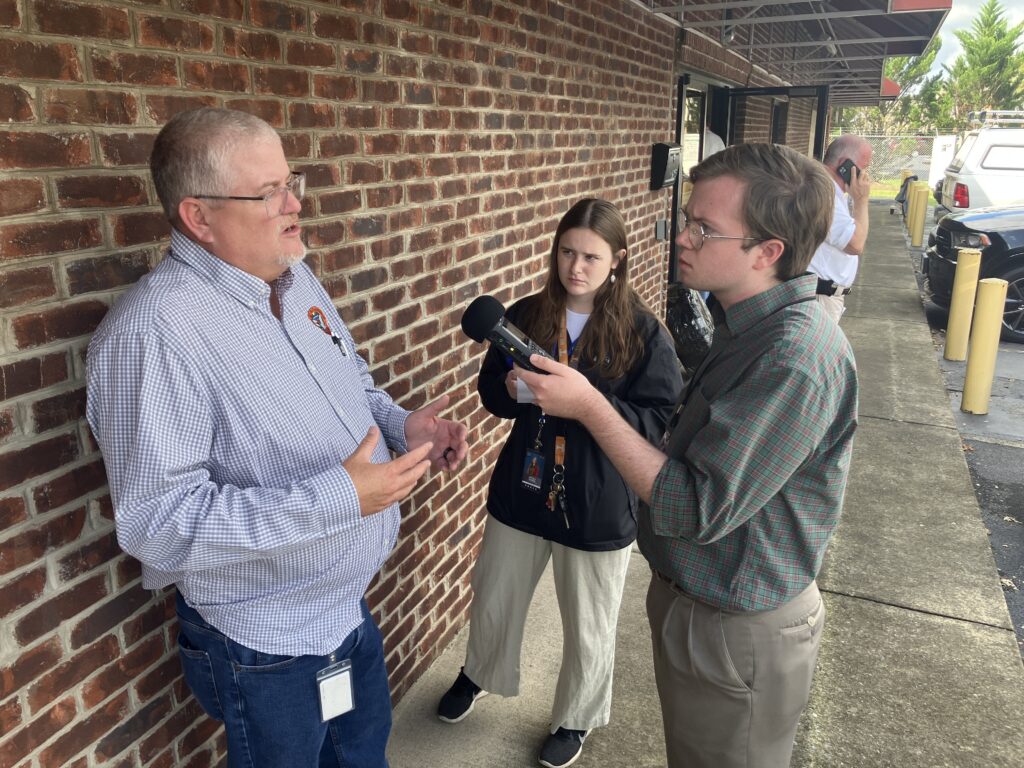
Pierce Gentry (right) of WUOT in Knoxville, Tenn., doing an interview out in the field. WUOT public radio is part of the Appalachia + Mid-South Newsroom collaboration
The funding will help them in a variety of ways, including:
- Mountain Top Media adding radio reporters to cover rural areas of Kentucky and Virginia.
- Athens County (Ohio) Independent hiring a business manager to take the workload off the newsroom’s leader.
- Enlace Latino NC expanding coverage into Western North Carolina, recruiting additional bilingual, bicultural journalists to be based in the region.
- Appalachia + Mid-South Newsroom, a public radio collaborative, adding a radio reporter at WMMT in Eastern Kentucky.
- Black by God | The West Virginian, an online publication, paying for a business and development manager.
- Allegheny Mountain Radio, a network of three community radio stations in Virginia and West Virginia, paying for a business and administrative person.
- West Virginia Public Broadcasting, a public media outlet, paying for a reporter to expand coverage of rural West Virginia.
- WMMT/Appalshop, a community radio station in Kentucky, paying for a reporter to expand coverage of Appalachian Kentucky.
Most news organizations, especially smaller rural ones, don’t have much experience taking on debt. So the local chapter is making sure they have wrap-around support from dedicated “navigators,” peer-directed cohort meetings and shared services.
Providing expert advice to newsrooms
Benjy Hamm, director of the Institute for Rural Journalism at the University of Kentucky, is one of the program’s navigators
With such a unique catalytic funding structure, the program required a lot of education and hand-holding for applicants right from the start. Jess Mullins Fullen, programs and learning manager at AFN, said that they had to build trust with funders around the program — and then with newsrooms.
“When we started our open call process, we had to build a lot of trust with newsrooms,” she said. “We had to host a couple of Q&A sessions, and even then, one of our application questions was, ‘What is your openness to this new opportunity as it relates to capital?’ And there isn’t a lot of comfortability. We’ve had to work really hard to build that with them. It’s a continuous process.”
Now that the program is in motion, each newsroom in the cohort has one navigator to advise them on specific business and operations matters. Flournoy, who is leading the navigator program and is a navigator himself, says that many newsrooms are led by people with more editorial experience than business acumen, so the navigators can provide fractional executive support.
“One of the really critical aspects of the Rural News Fund and the way our chapter operates is to get them strategic, executive, fractional help,” Flournoy said. “What are we going to do to build earned revenue channels, to manage expenses better — all of the things for a business operation? That’s what the navigator program is for, with experienced news industry executives who have worked on both the financial side and the editorial side of running news organizations.”
Plus, the newsrooms get access to all four navigators, depending on their needs. Kate Roselle, director of development for the Appalachia + Mid-South Newsroom, which is a collaborative of public radio stations, said that she appreciates getting access to the entire pool of navigators’ collective expertise.
“Benjy Hamm is our navigator, and he’s been really fantastic,” she said. “What I like the most about the program is that we’ve had access to all of the navigators, so I have specific one-on-one time with Benji, but I’ve also gotten to meet with the other navigators and access them. Being able to access all the navigators means we can truly act as a full cohort — not just a cohort with the newsrooms, but also with the navigators. There’s a sense that we’re all in it together.”
Letting the cohort drive the cohort meetings
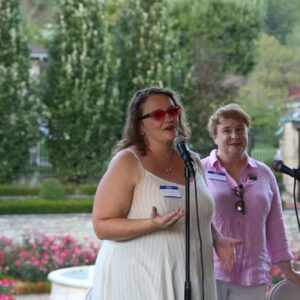
Emily Beveridge, development director of the Athens County Independent, with Corinne Colbert, co-founder and editor-in-chief, at a fundraiser in October 2025 (Photo courtesy of Athens County Independent)
The local chapter was deliberate about making sure its cohort meetings would be relevant and useful to attendees, letting the cohort drive the topics. Corinne Colbert, co-founder and editor in chief of the Athens County Independent, said that the cohort meetings have been helpful because they were focused on how they could serve grantees rather than having “experts yapping for an hour.” She gives kudos to consultant Emma Pepper, who has been coordinating the meetings.
“We were very honest about what we wanted and didn’t want,” Colbert said. “We didn’t want talking heads but wanted an opportunity for us to talk about specific subjects and share ideas, bounce ideas off each other and commiserate about our challenges. Emma has done a wonderful job, making sure the cohort meetings function in a useful way.”
Another member of the cohort, Emily Bango, director of development at Enlace Latino NC, appreciates the cohort meetings for providing a point of connection and potential collaboration. Building trust among newsrooms that are often spread out throughout the large geographic area can help build connections and amity while doing difficult work.
“One of the things that I really appreciate is the time that we get to know each other a little better, because a collaboration might not be instantaneous,” she said. “But when we have those connections, and we have that familiarity, it makes it easier when something might occur across state lines — that there’s a relationship that already exists.”
Finding more comfort around catalytic capital
None of the newsrooms in the cohort have had experience taking on debt, so the program includes a series of meetings to help them understand how that part of the program will work — along with one-on-one meetings with navigators. Bango from Enlace Latino NC says that she is becoming more comfortable with the idea of catalytic capital, knowing that she will have support every step of the way.
“I like that this is opening up the possibility of testing out a new revenue stream, and I hope it will help us successfully add to the diversification of our earned revenue,” she said. “We are trying something new and there is discomfort in that. What I trust is that we have well-intentioned and thoughtful experts who are in our corner and want to see us succeed, and that we have the opportunity to think creatively about how we could best make use of the loan. What’s exciting to me is that this process feels like a safer testing ground to try something new.”
Flournoy, who is leading the navigator program, says that the navigators will continue to work with newsrooms to help them understand how to take on flexible debt — and that it’s an important skill for newsrooms just as in any small business in any other sector.
“Using debt is scary and uncomfortable and uncharted territory for them,” he said. “But in my professional assessment, it’s absolutely critical to increase their very tough odds of success as small businesses. It’s work that Press Forward chapters and funders must do to restore and ensure the viability of the local news sector for years to come.”
Learn more about catalytic capital for local news.
Mark Glaser is a communications consultant for Press Forward, Knight Foundation, The Lenfest Institute and Tiny News Collective and was the founder and executive editor of MediaShift.org. He was formerly the director of business and program development for the New Mexico Local News Fund. He runs the Wind Power Media consultancy out of Santa Fe.